" width="82.5px"><path d="M 0 0 L 82.5 0 L 82.5 26.5 L 0 26.5 Z" fill="transparent" height="26.499999999999993px" id="jQVj7UWoR" transform="translate(0 0)" width="82.5px"/><path d="M 5.374 10.198 C 3.667 10.165 2.337 9.733 1.42 8.915 C 0.477 8.074 0 6.79 0 5.1 C 0 3.41 0.478 2.138 1.421 1.284 C 2.363 0.432 3.767 0 5.593 0 L 10.713 0.024 L 10.713 1.453 L 5.752 1.453 C 4.477 1.453 3.504 1.741 2.861 2.31 C 2.212 2.896 1.885 3.831 1.885 5.088 C 1.885 6.346 2.212 7.28 2.859 7.864 C 3.498 8.443 4.471 8.735 5.752 8.735 L 10.859 8.735 L 10.859 10.188 L 5.374 10.188 Z M 12.95 10.125 L 12.95 0.075 L 14.798 0.075 L 14.798 8.672 L 22.459 8.672 L 22.459 10.125 Z M 24.532 10.112 L 24.532 0.075 L 35.58 0.075 L 35.58 1.528 L 26.368 1.528 L 26.368 4.298 L 34.753 4.298 L 34.753 5.751 L 26.368 5.751 L 26.368 8.659 L 35.58 8.659 L 35.58 10.112 Z M 46.8 10.125 L 44.624 6.265 L 39.573 6.265 L 39.573 10.125 L 37.737 10.125 L 37.737 0.075 L 46.054 0.075 C 47.061 0.075 47.816 0.326 48.362 0.843 C 48.903 1.354 49.166 2.115 49.166 3.17 C 49.166 4.281 48.938 4.793 48.571 5.258 C 48.182 5.751 47.614 6.065 46.881 6.193 L 46.56 6.248 L 48.872 10.124 L 46.8 10.124 Z M 39.585 4.787 L 45.787 4.787 C 45.805 4.787 45.83 4.789 45.854 4.789 C 46.304 4.789 46.657 4.66 46.902 4.408 C 47.169 4.148 47.307 3.726 47.307 3.158 C 47.307 2.59 47.168 2.141 46.893 1.899 C 46.637 1.653 46.265 1.528 45.786 1.528 L 39.584 1.528 L 39.584 4.787 Z" fill="rgb(4, 1, 72)" height="10.198328571428576px" id="oG8UZ_P0a" transform="translate(32.905 7.83)" width="49.16649132080079px"/><path d="M 24.977 10.718 L 22.794 7.306 L 17.586 12.828 L 20.037 2.386 L 16.091 1.523 L 16.297 9.125 L 10.675 0 L 7.277 2.192 L 12.776 7.421 L 2.375 4.96 L 1.517 8.922 L 9.088 8.715 L 0 14.359 L 2.183 17.771 L 7.392 12.25 L 4.941 22.692 L 8.887 23.554 L 8.681 15.953 L 14.303 25.077 L 17.7 22.885 L 12.201 17.657 L 22.602 20.117 L 23.461 16.155 L 15.89 16.362 L 24.978 10.718 Z M 12.488 16.181 C 10.484 16.181 8.86 14.551 8.86 12.539 C 8.86 10.527 10.484 8.896 12.488 8.896 C 14.491 8.896 16.116 10.527 16.116 12.539 C 16.116 14.551 14.491 16.181 12.488 16.181 Z" fill="rgb(4, 1, 72)" height="25.07718571428565px" id="RuMDT4sRw" transform="translate(0.103 0.411)" width="24.977812427339074px"/></g></svg>)
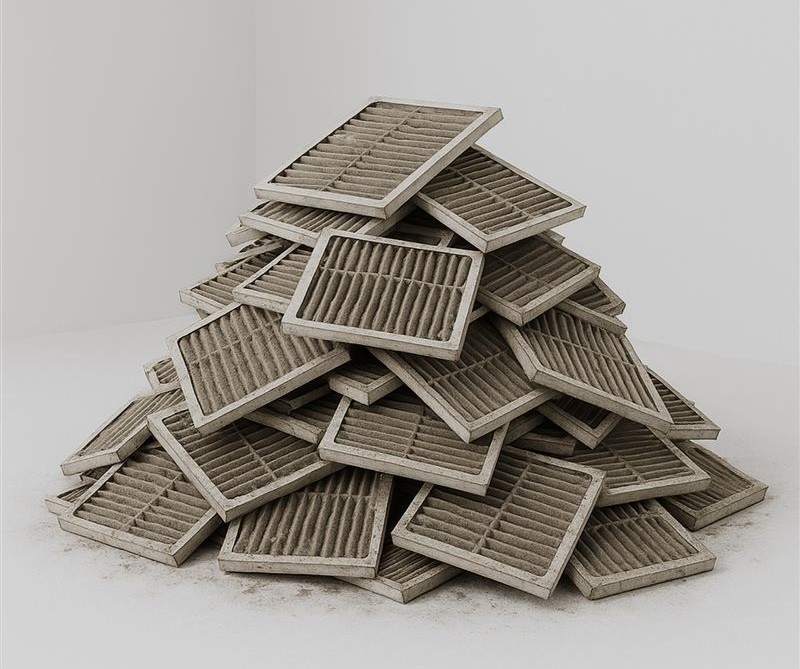
Frequent filter replacement happens when particles build up faster than filters can handle. To reduce replacement frequency, you need to reduce how particles accumulate in the system.
Why filters need to be replaced
Filters capture particles from the air. As they fill up:
Airflow decreases
Pressure increases
Performance drops
Eventually, the filter reaches capacity and must be replaced.
How often filters are replaced
Replacement frequency depends on:
Particle load
Operating hours
Environment
In high-load environments, filters may need replacement monthly, weekly, even more frequently
The limitations of filter-based systems
Filters solve one problem but create another. Performance drops over time As filters load, airflow becomes less efficient maintenance becomes constant. Filters require:
Monitoring
Replacement
Disposal
Costs increase
Each filter replacement adds:
Material cost
Labour
Downtime
Over time, this becomes a continuous expense.
Why common fixes don’t solve it
Typical approaches include:
Larger filters
Pre-filtration
More frequent cleaning
These extend filter life. However, they do not eliminate the need for replacement.
What happens when particles are removed instead of stored
Traditional filtration systems are built around storing particles. Over time, this leads to accumulation, reduced performance, and the need for replacement.
An alternative approach focuses on removing particles continuously, rather than capturing them in a filter.
When particles are separated from the airflow as they pass through the system, several things change:
Airflow remains consistent over time.
There is no buildup inside filters.
The system does not rely on replacement cycles to maintain performance.
This shifts the system from a maintenance-driven model to a continuous operation model.
Why filters need to be replaced
Filters capture particles from the air. As they fill up:
Airflow decreases
Pressure increases
Performance drops
Eventually, the filter reaches capacity and must be replaced.
How often filters are replaced
Replacement frequency depends on:
Particle load
Operating hours
Environment
In high-load environments, filters may need replacement monthly, weekly, even more frequently
The limitations of filter-based systems
Filters solve one problem but create another. Performance drops over time As filters load, airflow becomes less efficient maintenance becomes constant. Filters require:
Monitoring
Replacement
Disposal
Costs increase
Each filter replacement adds:
Material cost
Labour
Downtime
Over time, this becomes a continuous expense.
Why common fixes don’t solve it
Typical approaches include:
Larger filters
Pre-filtration
More frequent cleaning
These extend filter life. However, they do not eliminate the need for replacement.
What happens when particles are removed instead of stored
Traditional filtration systems are built around storing particles. Over time, this leads to accumulation, reduced performance, and the need for replacement.
An alternative approach focuses on removing particles continuously, rather than capturing them in a filter.
When particles are separated from the airflow as they pass through the system, several things change:
Airflow remains consistent over time.
There is no buildup inside filters.
The system does not rely on replacement cycles to maintain performance.
This shifts the system from a maintenance-driven model to a continuous operation model.